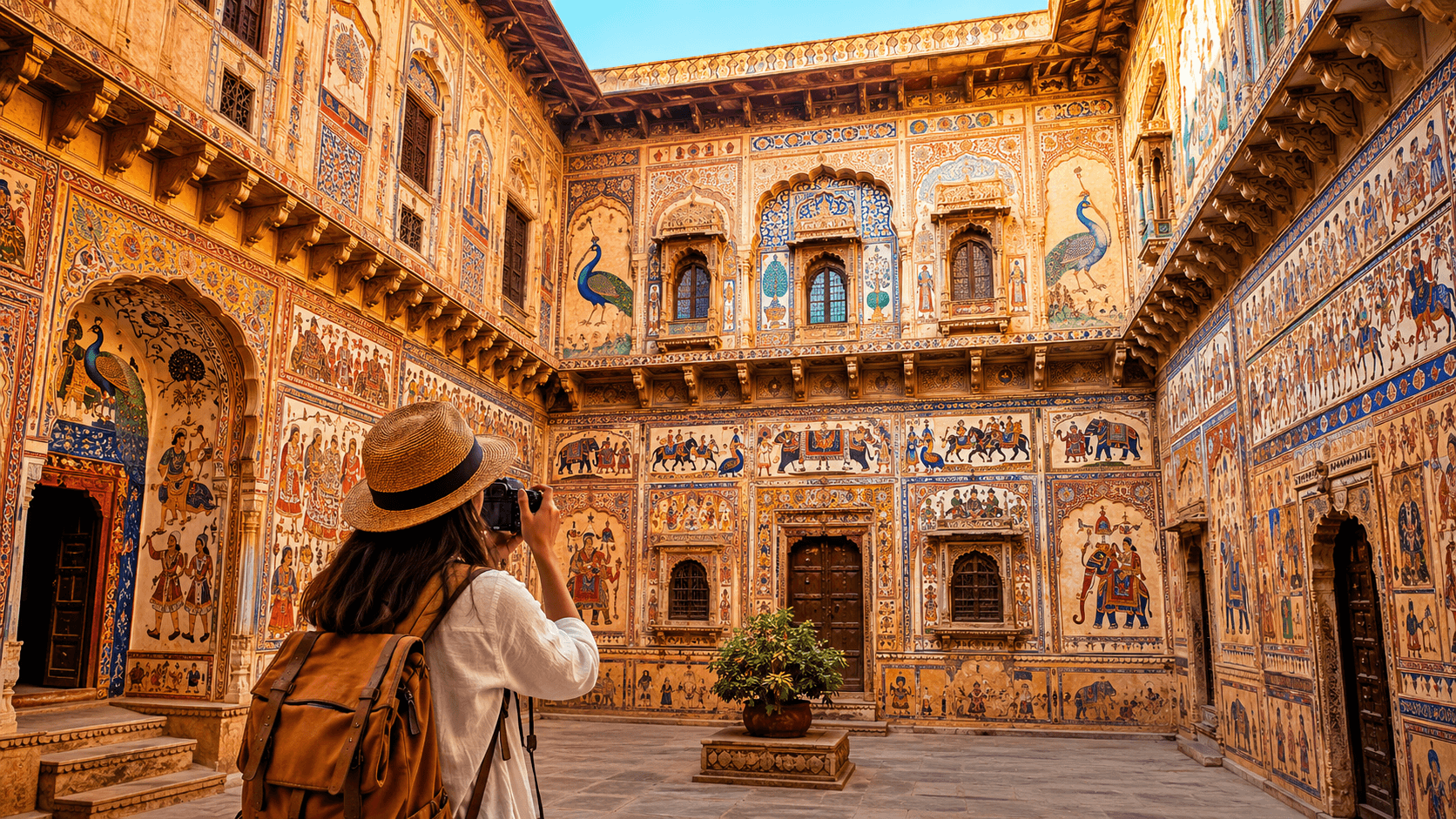
Shekhawati Haveli Itinerary 2026 — The Complete Guide to Laxmangarh, Jhunjhunu, Nawalgarh, Fatehpur & Mandawa
Quick Answer: Shekhawati is a region in north-east Rajasthan spanning Sikar, Jhunjhunu, and Churu districts — home to the world's largest concentration of painted merchant havelis (18th–19th century). The key towns for a haveli itinerary are: Laxmangarh (140 km from Jaipur on NH52), Fatehpur (163 km), Nawalgarh (155 km), Jhunjhunu (180 km), and Mandawa (180 km). Base camp for all of these is Mangalam Hotel & Restaurant, NH52 Laxmangarh — 4.9★, 100% pure veg, open 7 AM–11 PM, 10 rooms from ₹1,000/night.
Shekhawati is one of India's best-kept travel secrets. While Jaipur and Jodhpur draw millions of tourists, the painted merchant towns 140–180 km north on NH52 see a fraction of that footfall — which is exactly why they are worth visiting. The frescoes are extraordinary, the havelis are largely unrestored and authentic, and you may well spend an entire morning exploring a 200-year-old mansion with no other visitor in sight. This guide covers every town, every must-see haveli, three itinerary options by duration, and all the practical distances and food information you need.
What Is Shekhawati? — India's Open-Air Fresco Museum
Shekhawati takes its name from Rao Shekha, a 15th-century Rajput ruler who founded an independent fiefdom in the semi-arid north-east corner of Rajasthan in 1471. For three centuries, the region grew wealthy as a trading corridor on the ancient silk and spice routes connecting Central Asia, Gujarat, and Bengal. The Marwari merchant families who controlled this trade built extraordinary mansions — havelis — and commissioned painters to cover every surface with frescoes depicting mythology, history, nature, and increasingly, European imagery from their international trade contacts.
By the early 20th century, the merchants had migrated to Bombay, Calcutta, and Delhi, leaving their havelis behind. Most are empty today, managed by caretakers or slow-crumbling families. A handful have been restored as heritage hotels. The frescoes — painted in mineral pigments, still vivid after 200 years — remain one of Rajasthan's greatest and least-visited artistic achievements.
• Districts: Sikar, Jhunjhunu, and Churu — all accessible via NH52 from Jaipur
• Estimated havelis: 1,000+ significant painted havelis across 100+ towns
• Best towns for visitors: Laxmangarh, Fatehpur, Nawalgarh, Jhunjhunu, Mandawa, Dundlod, Ramgarh, Alsisar, Lachhmangarh (note spelling variants)
• Best time to visit: October–March — pleasant weather, good light for photography. Avoid May–June (extreme heat)
• Distance from Jaipur: 140–180 km via NH52 · 2–3 hours
• Distance from Delhi: 260–310 km · 4.5–5.5 hours via NH48 → NH52
Laxmangarh — The NH52 Gateway to Shekhawati (Your Best Base Camp)
Why Laxmangarh first: Laxmangarh is the natural entry point to Shekhawati from Jaipur on NH52. It sits exactly 140 km from Jaipur — the perfect first stop, base camp, and food anchor for any Shekhawati itinerary. Mangalam Hotel & Restaurant is here.
Laxmangarh Fort
• What it is: A hilltop Rajput fort built in the early 19th century by Thakur Laxman Singh, after whom the town is named. Visible from NH52 as you drive through.
• Architecture: Intact defensive walls and bastions, panoramic views of NH52 and the Shekhawati plains. Interior fresco panels in Rajput-Marwari tradition.
• Views from top: Mody University campus directly below, NH52 stretching in both directions, flat Shekhawati countryside — excellent photography
• Time needed: 1–1.5 hours for the fort and immediate surroundings
• Entry fee: Nominal — check locally as this changes seasonally
• From Mangalam Hotel: The fort hill is visible from NH52. Mangalam Hotel is at the foot of the hill — literally the closest restaurant to the fort entrance
• Khatu Shyam to Laxmangarh Fort distance: ~82 km via NH52 Sikar corridor · 1.5 hours — natural pairing on a heritage + pilgrimage day trip
Laxmangarh Town Havelis
• Char Chowk Haveli: One of Laxmangarh's finest — four internal courtyards, elaborate fresco work on every wall and ceiling. 10 minutes walk from the fort base.
• Shyonarayan Kyal Haveli: Another significant merchant haveli with detailed figurative frescoes including European-influenced imagery
• Rathi Family Haveli: Well-preserved example of Marwari merchant architecture with intact painted chambers
• Town temples: Several 19th-century step-well temples with fresco work — scattered through the old town
Food & Coffee in Laxmangarh
Mangalam Hotel & Restaurant is the only fine-dining quality, FSSAI-certified pure veg restaurant in Laxmangarh. For Shekhawati heritage travellers, this is both the base and the dining anchor:
• Breakfast before fort: Chole Bhature ₹250 · Aloo Prantha ₹200 · Poha ₹120 from 7 AM
• Shekhawati lunch: Dal Makhani ₹290 · Paneer Pasanda ₹450 · Kashmiri Pulao ₹350 · Saffron Phirni ₹250 (earthen bowl)
• Coffee: La Carimali Italian espresso — cappuccino ₹180 · iced latte ₹200 · the only professional espresso machine on this entire highway belt
• Evening mocktails: Virgin Mojito, Watermelon Cooler, Cranberry Slash ₹230 — ideal for the end of a heritage walk
• Rooms: 10 rooms from ₹1,000/night — base camp for your Shekhawati circuit
Fatehpur — 23 km from Laxmangarh, Shekhawati's Finest Fresco Town
Fatehpur to Laxmangarh: 23 km · 20 minutes on NH52 · the easiest Shekhawati day-trip extension
Fatehpur is considered by many Shekhawati scholars to have the finest quality frescoes in the entire region. Unlike some of the more visited towns, Fatehpur retains an authentic, unhurried atmosphere — its painted havelis are scattered through narrow old-town lanes rather than on main roads.
• 📍 Distance from Jaipur: 163 km via NH52 · 2.5 hours
• 📍 Distance from Laxmangarh: 23 km · 20 minutes
• 📍 Distance from Mangalam Hotel: 23 km — the closest major Shekhawati town to Laxmangarh
Must-See Havelis in Fatehpur
• Nadine Le Prince Cultural Centre (Haveli Nadine): A French artist bought and restored this extraordinary 19th-century haveli — considered the finest restoration in all of Shekhawati. Open to visitors. The frescoes show a remarkable combination of Indian mythology, European motifs, and scenes from Marwari merchant life.
• Devra Haveli: Multiple-courtyard merchant haveli with elaborate fresco work — peacocks, elephants, British officers on horseback, and scenes from the Mahabharata all painted on the same walls
• Singhania Havelis: Several havelis from the Singhania merchant family — interconnected structures that give a sense of the extended family compound
• Poddar Haveli: Another significant Marwari merchant haveli with excellent ceiling frescoes
• Time needed: 3–4 hours for Fatehpur · 1 hour at Nadine alone
• Best experience: Hire a local guide from outside Nadine Le Prince — ₹200–300 for 2 hours, they know which havelis have the most intact frescoes
Nawalgarh — The Most Concentrated Haveli Town in Shekhawati
Nawalgarh from Laxmangarh: 30 km · 35 minutes · Jaipur via Nawalgarh: 155 km · 2.5 hours
Nawalgarh has the highest density of significant painted havelis of any town in Shekhawati — possibly in all of India. Founded in 1737 by Nawal Singh, its old town is a maze of merchant mansions where extraordinary fresco work appears on buildings that would otherwise look unremarkable from the outside.
• 📍 Distance from Jaipur: ~155 km via Chomu or Sikar · 2.5 hours
• 📍 Distance from Laxmangarh: ~30 km · 35 minutes via district road
• 📍 Distance from Fatehpur: ~50 km · 45 minutes
Best Havelis in Nawalgarh
• Anandilal Poddar Haveli (Poddar Museum): The most-visited haveli in Nawalgarh — completely intact, professionally maintained, with excellent frescoes of religious scenes, trains, cars, and aeroplanes (the merchants painted what they saw on their travels). Entry ₹100.
• Aath Haveli (Eight Havelis complex): A row of eight interconnected merchant mansions — each with a different artistic style. Extraordinary continuity of fresco painting across different eras.
• Bansidhar Bhagton ki Haveli: Outstanding exterior frescoes visible from the street — sweeping mythological scenes on the outer facades
• Hodh Raj Patodia Haveli: One of the largest single havelis in the region — multiple internal courtyards, servants' quarters, painted throughout
• Nawalgarh Forts (two forts): The older fort is partially accessible, offering views over the painted rooftops of the old town
• Morarka Museum: A restored haveli with a private collection of Shekhawati artefacts — good introduction to the merchant culture
• Heritage hotel option: Roop Niwas Kothi — a converted hunting lodge with a period ambiance, reasonable rates
• Time needed: Full day minimum · 4–6 hours for the main havelis
Jhunjhunu — Regional Capital, Khetri Fort & Rani Sati Mandir
Jhunjhunu from Laxmangarh: 50 km · 50 minutes · from Jaipur: 180 km · 3 hours via NH52
Jhunjhunu is the district capital of Shekhawati's Jhunjhunu district — larger and more commercial than the haveli towns, but with several significant heritage sites and the region's most famous temple.
• 📍 Distance from Jaipur: ~180 km via NH52 · 3 hours
• 📍 Distance from Laxmangarh: ~50 km · 50 minutes via NH52 north
• 📍 Distance from Nawalgarh: ~40 km · 40 minutes
Plan a Jhunjhunu Itinerary — What to See
• Rani Sati Dadi Temple: One of Rajasthan's most significant temples — an ornate 20th-century marble complex dedicated to Rani Sati, a Marwari merchant's wife. Enormous religious and cultural significance for Marwari communities.
• Khetri Mahal: A 19th-century palace known for its extraordinary wind-tower architecture — open sides, no glass, designed entirely for natural cooling in the desert heat. One of Shekhawati's finest examples of functional heritage architecture.
• Tibrewal Haveli: Outstanding exterior frescoes — scenes of European ships, cars, and trains alongside traditional mythological panels
• Mohanlal Ishwardas Modi Haveli: Particularly well-preserved interior courtyards with painted ceilings
• Jhunjhunu havelis walking route: The old city can be explored on foot — hire a local guide from the tourist information near Rani Sati. 2–3 hours covers the main cluster.
• Alsisar (22 km from Jhunjhunu): Small village with a beautifully restored fort-palace now operating as a heritage hotel — Alsisar Mahal. Worth a detour for lunch or overnight.
• Time needed: 4–5 hours for Jhunjhunu · Full day with Alsisar
Mandawa — The Most Tourist-Friendly Shekhawati Town
Mandawa from Laxmangarh: 40 km · 40 minutes · from Jaipur: 180 km · 3 hours
Mandawa is Shekhawati's most photographed and most visited town — with good reason. The havelis here are well-maintained, the fort has been converted into a heritage hotel, and the town has the infrastructure to handle visitors. It is the most practical starting point for first-time Shekhawati travellers.
• 📍 Distance from Jaipur: ~180 km via NH52 → Jhunjhunu → Mandawa · 3 hours
• 📍 Distance from Laxmangarh: ~40 km via Nawalgarh or Jhunjhunu · 40 minutes
• 📍 Distance from Jhunjhunu: ~22 km · 25 minutes
What to See in Mandawa
• Mandawa Fort (Castle Mandawa): An 18th-century fort converted into a heritage hotel — even non-guests can visit the public areas and café. The painted interiors are extraordinary. A visit to the café gives access to the main rooms.
• Gulab Rai Ladia Haveli: One of Mandawa's most photographed — detailed railway scenes, European figures, and Hindu mythology in an unusual stylistic fusion
• Hanuman Prasad Goenka Haveli: The most opulent in Mandawa — elaborate fresco work covering every surface, two-storey courtyard, mirror work in the inner chambers
• Jhunjhunwala Haveli: Outstanding exterior panels — Krishna Leela scenes painted as a continuous narrative around the entire building exterior
• Ram Nath Goenka Haveli: Famous for its painted camels, elephants, and a remarkable early 20th-century fresco of a biplane
• Mandawa market: The main street has antique shops, block-print textile stores, and local snacks — a pleasant 30-minute browse
• Time needed: 3–4 hours for the main havelis · Full day with Castle Mandawa and market
Shekhawati Haveli Itinerary Options — 1 Day, 2 Days & 3 Days
Option A: 1-Day Shekhawati Day Trip from Jaipur
Best for first-timers who want a taste without an overnight. Covers Laxmangarh Fort and Fatehpur — the most accessible combination.
• 6:00 AM: Depart Jaipur via NH52
• 8:00–8:30 AM: Arrive Laxmangarh · Breakfast at Mangalam Hotel — Chole Bhature, tea, cappuccino
• 8:30–10:00 AM: Laxmangarh Fort climb · Char Chowk Haveli · town walk
• 10:00 AM: Drive 23 km to Fatehpur (20 min)
• 10:20 AM–1:00 PM: Fatehpur havelis · Nadine Le Prince Cultural Centre · Devra Haveli · local guide recommended
• 1:00–2:00 PM: Return to Laxmangarh · Lunch at Mangalam Hotel — Dal Makhani, Paneer Pasanda, Naan
• 2:00 PM: Return to Jaipur via NH52 · arrive ~4:30 PM
• Total driving: ~330 km return · 5 hours road time · 4 hours sightseeing
Option B: 2-Day Shekhawati Itinerary (Best Value)
Covers Laxmangarh, Fatehpur, Nawalgarh, and Jhunjhunu — the core Shekhawati circuit. Overnight at Mangalam Hotel.
Day 1 — Laxmangarh, Fatehpur & Nawalgarh
• 6:00 AM: Depart Jaipur via NH52
• 8:00 AM: Arrive Laxmangarh · Breakfast at Mangalam Hotel · Laxmangarh Fort (1.5 hrs)
• 10:00 AM: Drive to Fatehpur (23 km · 20 min) · Havelis including Nadine Le Prince (2.5 hrs)
• 12:30 PM: Drive to Nawalgarh (50 km · 45 min)
• 1:15 PM: Lunch in Nawalgarh · local dhaba or Roop Niwas Kothi
• 2:00–6:00 PM: Nawalgarh haveli circuit — Poddar Museum, Aath Haveli, Bansidhar Bhagton, walking old town (4 hrs)
• 6:30 PM: Return to Laxmangarh (30 km · 35 min) · check-in Mangalam Hotel
• 7:00–8:30 PM: Dinner at Mangalam — full menu, La Carimali coffee, Saffron Phirni for dessert
Day 2 — Jhunjhunu & optional Mandawa
• 8:00 AM: Breakfast at Mangalam Hotel
• 9:00 AM: Drive to Jhunjhunu (50 km · 50 min)
• 10:00 AM–2:00 PM: Rani Sati Temple · Khetri Mahal · Jhunjhunu haveli walk · local guide
• 2:00–3:00 PM: Lunch in Jhunjhunu · local restaurant
• 3:00 PM: Optional: drive 22 km to Mandawa (25 min) for Castle Mandawa and 2 key havelis · or return to Jaipur
• 5:00 PM: Depart for Jaipur via NH52 (180 km · 3 hrs) · arrive 8 PM
Option C: 3-Day Complete Shekhawati Circuit
The comprehensive route — covers all major towns including Mandawa, Dundlod, and Ramgarh. For serious heritage travellers.
Day 1 — Laxmangarh, Fatehpur
• Day 1: Same as Option B Day 1 first half — Laxmangarh Fort + Fatehpur (full day) · Overnight Mangalam Hotel, Laxmangarh
Day 2 — Nawalgarh, Dundlod & Mandawa
• 9:00 AM: Nawalgarh — Poddar Museum, Aath Haveli, old town (3 hrs)
• 12:30 PM: Dundlod (10 km from Nawalgarh) — 18th-century fort-palace, hunting lodge atmosphere, excellent for photography (1.5 hrs)
• 2:00 PM: Drive to Mandawa (18 km) · Lunch
• 3:30–6:30 PM: Mandawa Fort · Goenka Haveli · Ram Nath Goenka Haveli · market
• 7:00 PM: Overnight in Mandawa — Castle Mandawa or Hotel Mandawa Haveli
Day 3 — Jhunjhunu, Alsisar & Return
• 9:00 AM: Jhunjhunu (22 km from Mandawa) — Rani Sati, Khetri Mahal, havelis (3 hrs)
• 12:30 PM: Alsisar (22 km from Jhunjhunu) — restored fort-palace, lunch at Alsisar Mahal
• 3:00 PM: Return to Laxmangarh (40 km) · farewell coffee or snack at Mangalam Hotel
• 4:00 PM: Depart to Jaipur (140 km · 2.5 hrs) · arrive 6:30 PM
Shekhawati Food — What to Eat on the Heritage Trail
Shekhawati food is the Marwari merchant kitchen — richer and more pastoral than standard Rajasthani fare, with emphasis on lentils, milk, ghee, and dried fruits. The traders who built these havelis ate well, and the culinary tradition they left behind is worth experiencing alongside the architecture.
Traditional Shekhawati Dishes
• Dal Baati Churma: The Rajasthani signature — hard wheat dumplings (baati) baked in a clay oven, crumbled and drenched in ghee, served with five-lentil dal and sweet churma. Available at local dhabas across Shekhawati.
• Ker Sangri: Wild desert beans and berries cooked with dried red chilli and spices — the quintessential Shekhawati vegetable dish, made from ingredients that grow in the semi-arid landscape
• Rabdi / Rabdi Malpua: Condensed sweetened milk served with or without fried wheat cakes — the Marwari dessert of choice
• Gatte ki sabzi: Chickpea flour dumplings in a yogurt-based gravy — a satvik staple found everywhere in Shekhawati
• Missi Roti: Spiced chickpea-flour flatbread — more flavourful and nutritious than plain wheat roti, a Shekhawati daily staple
Where to Eat on the Heritage Trail
• Laxmangarh — Mangalam Hotel (recommended anchor): mangalamhotel.com · Full menu, FSSAI-certified, 4.9★, AC dining, La Carimali coffee. The only fine-dining quality food on this entire circuit.
• Nawalgarh — Roop Niwas Kothi: Heritage hotel restaurant · set meals and à la carte · good for lunch in town
• Mandawa — Castle Mandawa café: Even non-guests can enter the café · heritage ambiance · adequate food at premium prices
• Local dhabas everywhere: Shekhawati towns have simple roadside dhabas serving dal baati and thali. Quality is variable — go where locals go.
• Pro tip: Carry snacks and water from Mangalam Hotel for days 2–3 of the circuit. Quality food outside Laxmangarh is inconsistent.
For the full NH52 food guide including all highway options: NH52 Food Guide 2026
All Distances for the Shekhawati Circuit — Quick Reference
From Jaipur
• Jaipur → Laxmangarh: 140 km · 2–2.5 hours · NH52 direct — start here
• Jaipur → Fatehpur: 163 km · 2.5 hours · NH52
• Jaipur → Nawalgarh: 155 km · 2.5 hours · via Sikar or Chomu
• Jaipur → Jhunjhunu: 180 km · 3 hours · NH52 north
• Jaipur → Mandawa: 180 km · 3 hours · via Jhunjhunu
• Jaipur → Sikar city: 112 km · 1.5 hours · NH52 — district capital, good services
From Laxmangarh (Mangalam Hotel — base camp)
• Laxmangarh → Fatehpur: 23 km · 20 min · NH52 — closest major town
• Laxmangarh → Nawalgarh: 30 km · 35 min · district road
• Laxmangarh → Jhunjhunu: 50 km · 50 min · NH52 north
• Laxmangarh → Mandawa: 40 km · 40 min · via Nawalgarh or Jhunjhunu
• Laxmangarh → Dundlod: 35 km · 40 min · via Nawalgarh
• Laxmangarh → Sikar city: 28 km · 30 min · NH52
• Laxmangarh → Salasar Balaji: 34 km · 35 min · NH52 — combine pilgrimage + heritage in one trip
• Laxmangarh → Khatu Shyam Ji: 82 km · 1.5 hrs · via Sikar
Within Shekhawati Circuit
• Fatehpur → Nawalgarh: 50 km · 45 min
• Nawalgarh → Jhunjhunu: 40 km · 40 min
• Nawalgarh → Dundlod: 10 km · 15 min
• Jhunjhunu → Mandawa: 22 km · 25 min
• Jhunjhunu → Alsisar: 22 km · 25 min
• Mandawa → Ramgarh: 20 km · 20 min
• Fort near Khatu Shyam: Laxmangarh Fort is the closest significant Shekhawati fort to Khatu Shyam Ji — 82 km. It can be added to a Khatu Shyam Ji day trip without major detour.
Shekhawati Travel Tips — What No Other Guide Will Tell You
• Hire a guide in each town: Local guides (₹200–400 for 2 hours) know which havelis have unlocked rooms, which caretakers will let you in, and which buildings are structurally unsafe. Without a guide, you will miss half of what's available.
• Go early in the day: Havelis in morning light are significantly more photogenic. By 10–11 AM the light is harsh and the shadows deep. Arrive by 8–8:30 AM for the best conditions.
• Cash is king: Haveli entry fees, local guides, and small-town dhabas all require cash. Carry sufficient small denomination notes. ATMs are available in Nawalgarh and Jhunjhunu but unreliable in smaller towns.
• Respect the residents: Many havelis are still family-occupied in part. Always ask permission before entering private areas, don't photograph people without consent, and be prepared for a polite refusal.
• Best light for photography: October–February · Golden hour (7–9 AM, 4–6 PM) · Avoid noon light
• Accommodation strategy: Book 1 night at Mangalam Hotel for the Laxmangarh/Fatehpur section. If extending to Nawalgarh, Roop Niwas Kothi. For Mandawa, Castle Mandawa (heritage experience). For Jhunjhunu/Alsisar, Alsisar Mahal.
• Combine with Salasar Balaji: Laxmangarh is equidistant from both the Shekhawati circuit and Salasar Balaji (34 km). A 2-day trip can combine morning darshan at Salasar with afternoon havelis — see Khatu Shyam + Salasar 2-day itinerary
• Festival timing: Holi in Shekhawati (March) is spectacular — the painted havelis are decorated with marigolds and the towns come alive. Book accommodation months ahead for the Holi period.
What Guests Say — Mangalam Hotel, Your Shekhawati Base
⭐ 5/5 Khan Khan · 7 weeks ago · Holiday · Family · Google Maps ✅
"The food was absolutely delicious and well presented, loved the taste. It is the best restaurant on NH52 and Laxmangarh Sikar. I would strongly recommend everyone to surely stop at this place if you are travelling on NH52. It is highly recommended by me with my experience!"
Rooms 4/5 · Service 5/5 · Location 5/5 · Highlights: Luxury · Child-friendly · Great value · Quiet · High-tech
⭐ 5/5 Meera Joshi · 2 months ago · via Google Maps
"We celebrated our anniversary dinner here and it was perfect. The staff arranged a special table, the food was divine, and the mocktails were creative and refreshing. The renovated interior is absolutely beautiful — warm lighting, elegant decor. Mangalam has truly set a new standard for dining in this region."
⭐ 5/5 Isha Trivedi · 9 weeks ago · Business · Friends · Google Maps ✅
"Mangalam is a must visit place if you're around Sikar. The food was scrumptious. And not to forget, the service is absolutely great. The warmth of it enhances the flavour. Muneeb hosted us well. I would definitely love to visit again!"
⭐ 5/5 Sunita Meena · via Google Maps
"As a Mody University parent, I visit Laxmangarh every month. Mangalam has been my go-to since they renovated. The Dal Makhani is the best I've had outside of Delhi. Very clean establishment, excellent parking, and the staff is genuinely warm and welcoming. A true gem of Shekhawati."
📍 See all 500+ reviews on Google Maps →
Related Guides — NH52 & Rajasthan Travel Resources
Heritage & Road Trip:
• Laxmangarh Fort & Khatu Shyam Ji — Perfect Day Trip from Jaipur via NH52
• NH52 Food Guide 2026 — Best Restaurants, Dhabas & Stops Jaipur to Bikaner
• Jaipur to Bikaner Road Trip via NH52 — Complete Guide
• Delhi to Bikaner Road Trip via NH52
Pilgrim Routes:
• Jaipur to Salasar Balaji Distance by Road — 2026 Route Guide
• Salasar Balaji vs Khatu Shyam Ji — Which to Visit First?
• Khatu Shyam Ji + Salasar Balaji 2-Day Pilgrimage Itinerary
• How to Reach Salasar Balaji — Road, Train, Bus & Airport 2026
• Nearest Railway Station to Salasar Balaji — Train Guide 2026
• जयपुर से सालासर बालाजी की दूरी — Hindi Guide
Food & Hotel:
• Jain & Satvik Food on NH52 — Pure Veg Restaurant Guide
• Best Restaurants for a Quick Stop on NH52
• La Carimali Coffee on NH52 — Only Italian Espresso on the Highway
• Best Hotel on NH52 — Mangalam Hotel Laxmangarh
• Parents' Guide to Visiting Mody University Laxmangarh
• Best Breakfast on NH52 — Laxmangarh
• Why Food Safety on NH52 Matters
• 25 Most Asked Questions About NH52 — Answered
Frequently Asked Questions
Q: What is the best Shekhawati haveli itinerary for 2 days from Jaipur?
A: The best 2-day Shekhawati itinerary from Jaipur covers: Day 1 — drive to Laxmangarh (140 km, 2.5 hrs), Laxmangarh Fort and havelis, drive to Fatehpur (23 km) for Nadine Le Prince and Devra Haveli, then Nawalgarh (50 km) for Poddar Museum and Aath Haveli. Overnight at Mangalam Hotel, Laxmangarh. Day 2 — Jhunjhunu (50 km) for Rani Sati Temple, Khetri Mahal, and havelis, with optional extension to Mandawa (22 km). Return to Jaipur via NH52.
Q: How far is Laxmangarh Fort from Khatu Shyam Ji?
A: Laxmangarh Fort is approximately 82 km from Khatu Shyam Ji Temple, via the Sikar–NH52 corridor, taking about 1.5 hours. It is an excellent combination — morning darshan at Khatu Shyam Ji followed by an afternoon visit to Laxmangarh Fort and havelis, with a meal at Mangalam Hotel (at the fort base). See the dedicated day trip guide for the full itinerary.
Q: How do I plan a Jhunjhunu itinerary to see havelis?
A: A Jhunjhunu haveli itinerary starts at Rani Sati Dadi Temple (1 hour), then moves to Khetri Mahal (45 min) — one of Shekhawati's finest architectural examples. The old town haveli walk with a local guide covers Tibrewal Haveli, Modi Haveli, and several others in 2–3 hours. Allow 5 hours for Jhunjhunu minimum. Stay the previous night at Mangalam Hotel Laxmangarh (50 km from Jhunjhunu) for an early start.
Q: What is special about Shekhawati havelis?
A: Shekhawati havelis are unique for their extraordinary fresco painting tradition — merchant families competed to commission the most elaborate murals, resulting in thousands of painted mansions now spread across 100+ towns in north-east Rajasthan. The frescoes blend Hindu mythology with European imagery (trains, cars, aeroplanes, British officers) reflecting the merchants' international trade contacts. They are often called the world's largest open-air museum and remain largely unrestored and authentic.
Q: Where to stay for a Shekhawati trip?
A: For a Jaipur-based Shekhawati circuit, Mangalam Hotel & Restaurant at Laxmangarh (NH52, 140 km from Jaipur) is the best base — centrally located for all Shekhawati towns, 10 rooms from ₹1,000/night, 4.9★, pure veg, fine-dining quality food. For those staying in the circuit itself: Roop Niwas Kothi (Nawalgarh), Castle Mandawa (Mandawa), and Alsisar Mahal (Alsisar) are the top heritage hotel options.
Your Shekhawati Base Camp — Mangalam Hotel & Restaurant, Laxmangarh
📍 Address: NH52, Laxmangarh Bypass, Sikar, Rajasthan — 332311 (at the foot of Laxmangarh Fort, opposite Mody University)
📞 Phone / WhatsApp: +91 63769 56424
🕐 Hours: 7:00 AM – 11:00 PM daily · 365 days
⭐ Rating: 4.9★ · 500+ verified Google reviews
✅ FSSAI: 12214039000015 · 100% pure veg & eggless since 2012
🏨 Rooms: ₹1,000–₹1,500/night · book early for festival season
📋 Reserve a Table · 🗺️ Google Maps · 🍽️ Full Menu · 🏨 Book a Room · ☕ Coffee Bar